Almost everyone who lives with joint pain knows the feeling: the cold months arrive, and the stiffness, aching, and reduced mobility arrive with them. It is so common that it is easy to dismiss as inevitable. But Ayurveda has a precise explanation for why cold weather aggravates the joints — and that explanation is not just interesting. It points directly toward the root.
How Ayurveda Understands Joint Pain in Cold Weather
To understand why cold worsens joint pain, Ayurveda looks at the qualities involved. Vata — the dosha governing movement, the nervous system, and the spaces within the body — is by nature cold, dry, light, and mobile. The joints themselves are considered a primary seat of Vata. And winter is the most Vata-aggravating season of all: cold, dry, and windy.
When the cold, dry qualities of winter meet the cold, dry nature of Vata in the joints, like increases like. Vata becomes aggravated precisely where it already concentrates. The result is exactly what so many people feel: stiffness, cracking, dryness in the joints, aching that worsens with cold, and reduced range of motion. The lubrication and cushioning the joints rely on diminish, and movement becomes harder.
This is also why warmth and oil bring such reliable relief. If cold and dryness aggravate the joints, then warmth and moisture soothe them — this is the Ayurvedic principle of opposites in its simplest form. A warm compress, warm oil, a warm climate, warming food: each counters the very qualities driving the pain.
There is a second pattern worth knowing. Some joint pain, particularly when it comes with heat, swelling, redness, and inflammation, involves ama — the metabolic residue of poor digestion — lodging in the joints, often combined with Pitta-type heat. This kind of joint pain behaves differently and may not follow the cold-weather pattern as clearly. Knowing which pattern is yours shapes the whole approach.
The Patterns Behind Joint Discomfort
Joint discomfort rarely shows up alone. These are the connected patterns Ayurveda addresses together.
- Cold-Weather Stiffness Joints that stiffen and ache as the temperature drops, easing with warmth and movement. The classic Vata-in-the-joints pattern this article centres on — dry, cold, and responsive to warming care.
- Cracking, Popping, and Dryness Joints that crack and pop, a sense of dryness or lack of lubrication, discomfort that comes with too much movement or too little. A Vata signature, pointing toward the need for internal and external oiliness.
- Morning Stiffness Stiffness that is worst on waking and eases as the body warms and moves. Understood in Ayurveda through the accumulation that settles overnight and the warmth and movement that disperse it.
- Heat, Swelling, and Inflammation Joints that are warm, swollen, red, or inflamed — a different pattern, involving ama and Pitta-type heat, that calls for cooling and detoxifying work rather than warming.
- Aching That Tracks the Weather Discomfort that rises and falls with cold fronts, damp, and barometric change. A reflection of how sensitive Vata-governed joints are to the qualities of the environment.
- Reduced Mobility and Comfort The gradual narrowing of easy movement, the carefulness that creeps into how you move. Ayurveda approaches this through warmth, lubrication, gentle movement, and the reduction of what aggravates the joints.
The Ayurvedic Approach to Joint Comfort
Ayurvedic work with joint discomfort centres on countering the qualities that aggravate the joints — most often cold and dryness — and supporting the body's own lubrication and ease of movement. It begins with understanding your specific pattern: whether your joint pain is the dry, cold Vata type, or the hot, inflamed ama-and-Pitta type, since these call for opposite approaches. From there, the work typically includes several layers.
- Warmth and oil are central for the Vata-type pattern. Abhyanga — warm oil self-massage — is one of the most valued Ayurvedic practices for the joints, bringing warmth and lubrication directly to where Vata concentrates. Warm sesame oil is traditional. Warm compresses, warm baths, and keeping the joints covered in cold weather all follow the same principle.
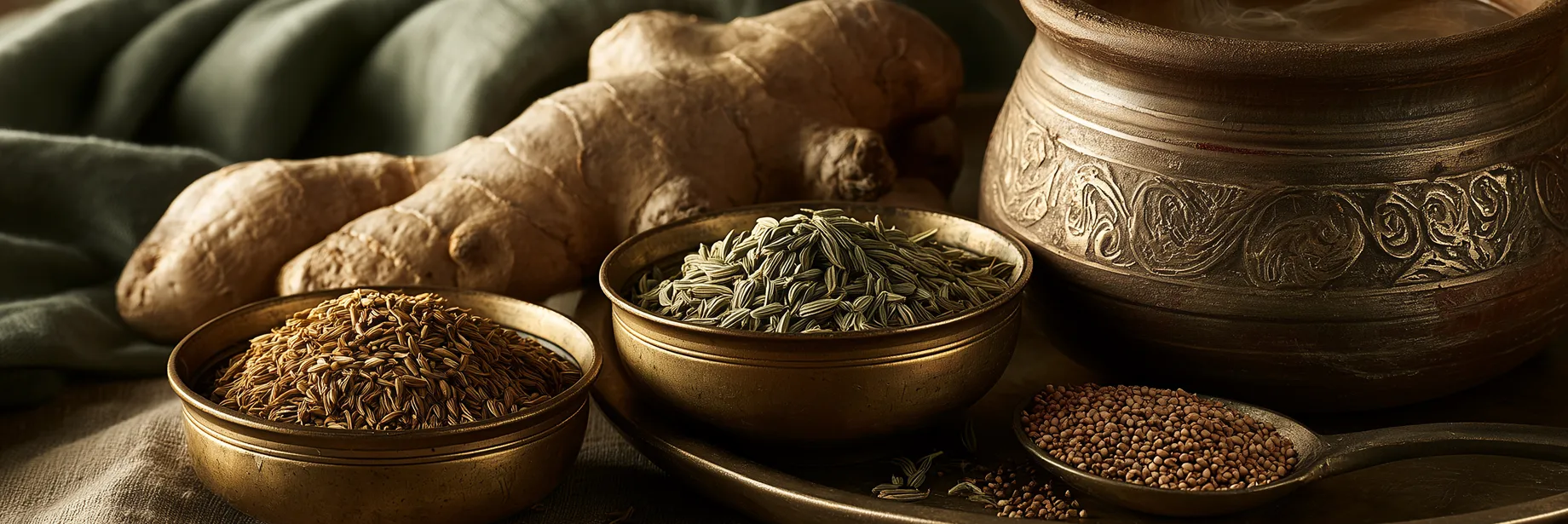
- Food and internal warmth matter as much as external care. Warm, cooked, nourishing meals; healthy oils and fats that support internal lubrication; warming spices such as ginger, turmeric, and cinnamon; and the reduction of cold, dry, raw foods that aggravate Vata. For the inflammatory ama-and-Pitta pattern, the dietary approach shifts toward cooling and toward clearing ama through improved digestion.
- Movement keeps the joints supple. Gentle, regular movement — not the intense exertion that aggravates Vata, nor the stillness that lets stiffness settle, but the steady middle path that maintains mobility and circulation.
- Herbal support draws on traditional Ayurvedic preparations long used for the joints and for healthy inflammation response — among them turmeric, ginger, guggulu, ashwagandha, and Boswellia — selected for your specific pattern. These are recommendations, not prescriptions, chosen for your individual picture.
- Seasonal awareness ties it together. Because winter is the most aggravating season for Vata-type joint pain, Ayurveda emphasises increasing warmth, oil, and grounding care as the cold arrives — meeting the season before it settles into the joints.
Most people working with Ayurveda for joint comfort notice early shifts — less stiffness, easier movement, more comfort through cold weather — within several weeks of consistent warming and lubricating care. Deeper, lasting change unfolds over months and across seasons.
Closing line of section: This is one of the areas where Vaidya Vaishali's practice runs deepest. You can read more about how she works with Joint Mobility & Body Comfort.
Joint Mobility & Body Comfort
Working Alongside Your Doctor
Ayurvedic support for joint comfort is designed to complement, never replace, medical care. Joint pain can stem from many causes — among them osteoarthritis, rheumatoid arthritis, gout, injury, and autoimmune conditions — several of which require proper medical diagnosis and management. If your joint pain is new, severe, accompanied by significant swelling or redness, or progressively worsening, please see a physician. Inflammatory and autoimmune joint conditions in particular need medical care.
Many people find that, alongside their medical care, Ayurvedic warming, dietary, lifestyle, and herbal work supports comfort and mobility in daily life. Vaidya Vaishali does not advise stopping or adjusting any medication; those decisions remain between you and your prescribing physician.
Where to Begin
If you recognise your own experience in this article, the starting point is understanding your specific pattern. Joint discomfort looks different from person to person — the dry, cold type and the hot, inflamed type call for opposite care — and the Ayurvedic approach depends entirely on which is driving yours.
A consultation with Vaidya Vaishali begins with a comprehensive picture of your constitution, your joint history, your daily patterns, and your goals — and from there, a personalised wellness protocol shaped to your body.